From mutual funds to private markets: the next battleground for asset managers

Investor appetite for alternative assets – from infrastructure and private debt to private equity and real estate – is growing rapidly.
A growing slice of the pie
Alternatives now account for around $22 trillion, or roughly 15% of global AUM, according to the Investments & Wealth Institute, a share that is expected to keep rising as investors continue to seek diversification.
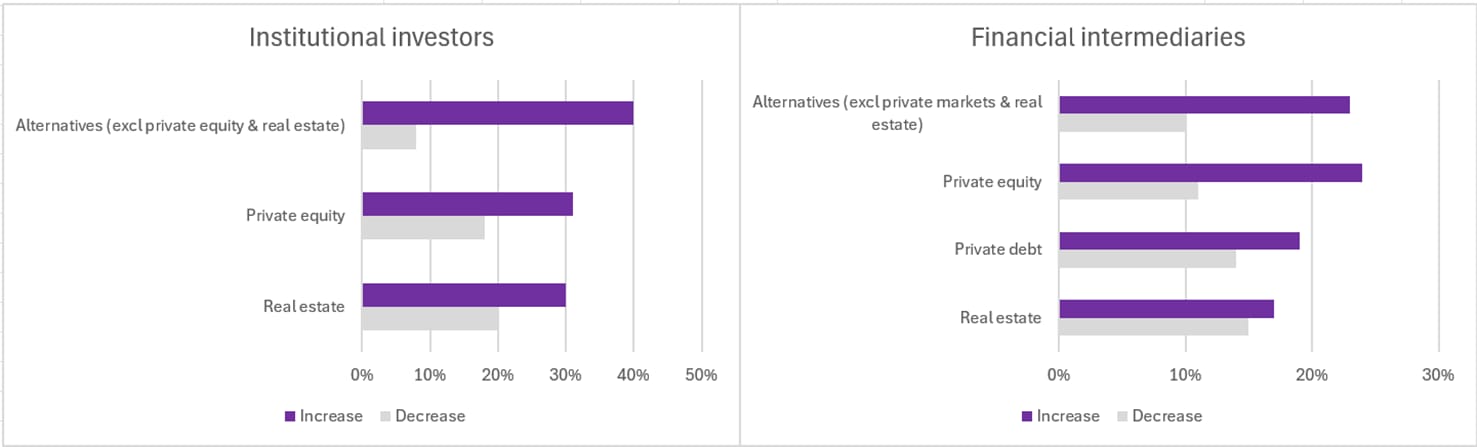
When asked which asset classes they plan to increase/decrease over the next 12 months, both institutional investors and financial intermediaries in the US plan to increase their allocations to alternatives, Aureum Y, Fundamental Group’s research division, recently found. In our 2025 US institutional survey, 40% of respondents indicated they plan to increase exposure to alternatives (excluding private equity and real estate), while 23% of financial intermediaries plan an increase, according to our 2025 US intermediary survey.
Opening doors to new investors
Historically, alternatives were the preserve of professional investors. That’s changing. Wealthy individuals are increasingly in focus, and with retail investors controlling 16% of global wealth – but with only a small share in alternatives – the potential is huge.
Policy is also shifting. In August, President Trump signed an executive order allowing assets such as private equity, real estate and even cryptocurrencies to be included in 401(k) plans. That could open up the $12 trillion US retirement market, though regulators have cautioned on liquidity, valuation and fee risks.
Traditional managers join the fray
We’ve already seen a wave of more traditional managers stepping into the alternatives space with firms WisdomTree, State Street Investment Management and Franklin Templeton actively marketing new products in the US during 2025.
Over the past few years, several large asset managers have launched alternatives funds, including:
- JPMorgan Private Markets Fund, launched in 2023
- Franklin Templeton’s FLEX-I, a registered tender-offer private equity secondaries fund designed for the US wealth channel
- BlackRock’s Private Financing Solutions
- Goldman Sachs plans to launch a private credit collective investment trust targeting defined-contribution retirement plans like 401(k)s in Q4 2025
Positioning for success
So how can traditional managers cut through in this increasingly competitive market?
While specialists still lead on product depth, traditional firms have clear advantages in scale, distribution, client service and brand trust. With the retail shift toward alternatives accelerating, these strengths are well-suited to capture flows – if managers can differentiate their story.
Five strategies stand out:
1. Craft
a narrative of accessibility
Emphasise how new fund structures (e.g. evergreen models, semi-liquid vehicles,
advisor-friendly platforms) make alternatives more approachable to a broader
audience.
2. Balance
performance with transparency
Highlight the long-term outperformance of private markets while being
upfront about liquidity limits, fees and risks.
3. Highlight
innovation and access
Emphasise how digital platforms, advisor partnerships and new distribution
models are opening the door to investors who once couldn’t participate.
4. Differentiate
your POV
Play to your strengths: scale, service, breadth of solutions. Don’t just
follow specialist narratives – own your difference.
5. Meaningful
messaging
More visibility doesn’t always equal more credibility. Prioritise quality
storytelling, data-driven insights and consistent brand messaging over
reactive noise.
As the alternatives landscape matures, the winners will be those who can combine credibility with creativity, bringing institutional-grade opportunities to new audiences without compromising on transparency or trust. For traditional managers, this means reshaping their role in an evolving investment ecosystem. Those who lean into their advantages in scale, distribution and brand, while tailoring products and messages to a broader investor base, will be best placed to capture lasting market share in the decade ahead.

Active ETFs vs managed funds: the art of selling without self-sabotage
How do you differentiate the traditional managed fund and the newer active ETF without blurring their value or cannibalising demand?

Is there a right time to share your market outlook?
How timing, format and channel strategy shape adviser engagement

VIDEO: The pace of change in marketing
In this short video, we explore whether asset management marketers are equipped to keep pace with this rapid transformation.